Sustainability in Action
Forest Fire Prevention and PM2.5 Air Pollution Mitigation Project
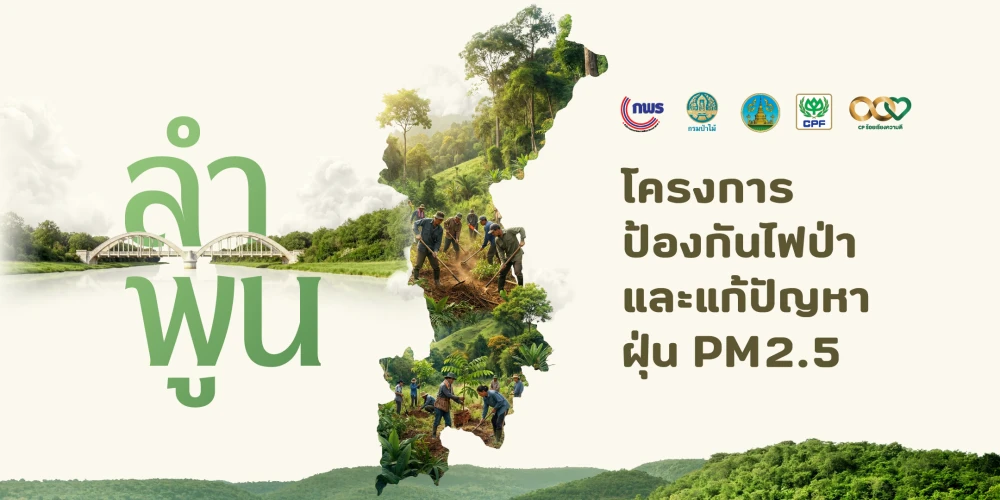
The Royal Thai Government has designated the mitigation of fine particulate matter, or PM2.5, as a national agenda item through the announcement of the second National Action Plan on Dust Pollution Mitigation for 2025–2027, together with a five-year action framework. Mae Tha District in Lamphun Province is among the areas with one of the highest accumulated numbers of forest hotspots in the province. In response, CPF has collaborated with the Lamphun Provincial Office, the Office of the Public Sector Development Commission (OPDC), the Royal Forest Department, local authorities, and communities to implement the Forest Fire Prevention and PM2.5 Mitigation Project. The project covers 12 community forests, spanning more than 20,000 rai in Tha Pla Duk and Sop Tia Subdistricts, Mae Tha District, Lamphun Province. CPF supports equipment and knowledge-sharing to strengthen local communities’ capacity to manage forest areas and prevent forest fires effectively. The initiative also promotes the processing of leaves and unused biomass to reduce risk factors associated with forest fires and open burning, while encouraging the efficient use of resources to help enhance long-term livelihood security for local communities.

12 community forests

More than 20,000 rai

December 2025 – December 2028
Project Implementation Approach
1. Supporting Forest Fire Prevention and Control Equipment
- Provide tools and equipment for forest fire monitoring, prevention, and control.
- Support essential equipment such as blowers, communication radios, and dust masks.
- Strengthen community preparedness to respond effectively to forest fire incidents.
2. Strengthening the Capacity of Communities and Youth
- Provide training on forest fire prevention and control.
- Promote the processing of forest and agricultural residues into biomass fuel.
- Reduce the accumulation of natural fuel in forest areas and minimize open burning.
- Raise awareness of natural resource conservation.
- Create opportunities for children and youth to participate in local environmental stewardship.
3. Building Multi-Stakeholder Collaboration
- Promote collaboration among government agencies, the private sector, and local communities.
- Work together to address forest fires, PM2.5 pollution, and their impacts on communities.
- Build a continuous environmental collaboration network.
- Strengthen long-term shared stewardship of community forests.
Implementation in 2025
- Conducted field surveys.
- Engaged communities and relevant agencies in developing a three-year action plan.
Implementation Plan for 2026
- Plan and monitor forest fire risks in the project areas.
- Provide tools and equipment for forest fire monitoring, prevention, and control.
- Conduct forest fire prevention and control training led by experts from the Royal Forest Department.
- Provide knowledge-sharing sessions and organize study visits for communities on value-added processing of forest and agricultural residues, in collaboration with lecturers from Maejo University.
- Organize creative learning activities for youth to raise awareness of forest fire prevention.
- Engage employees through environmental conservation activities that reflect the cultural context of local communities.

Forests and communities form the foundation of quality of life.
When natural resources are cared for with understanding, they become the starting point for cleaner air and a more sustainable future.”
