Materiality Assessment and Stakeholder Engagement

Materiality Assessment
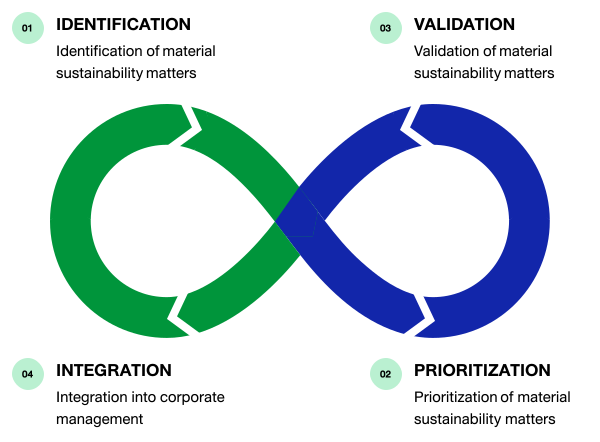
The material sustainability issues disclosed in the CPF Sustainability Report have been established in accordance with the principles of the GRI Standard 2021 (GRI 3) to assess material sustainability issues under the four principles of the GRI Standard, which are Sustainability Context, Materiality, Completeness and Stakeholder Inclusiveness.
There are 4 significant sustainability assessment process as follows:
Understanding the Organization’s Context
Identifying Actual and Potential Impacts
Assess the Significance of the Impacts
Prioritize the Most Significant Impacts for Reporting
Stakeholder Engagement
Stakeholder engagement is a crucial foundation to any sustainable organization. At CPF, we make every effort to actively engage and work with all of our stakeholders, from individuals to organizations that have an interest in our business activities.
We routinely conduct reviews to identify and engage with stakeholders. Through various communication channels and activities, we identify the needs, concerns, and opinions of our stakeholders, which are then appropriately and equitably incorporated into our sustainability practices. We also continuously seek an appropriate level of communication with each stakeholder, while balancing our internal work plans with stakeholders’ needs.
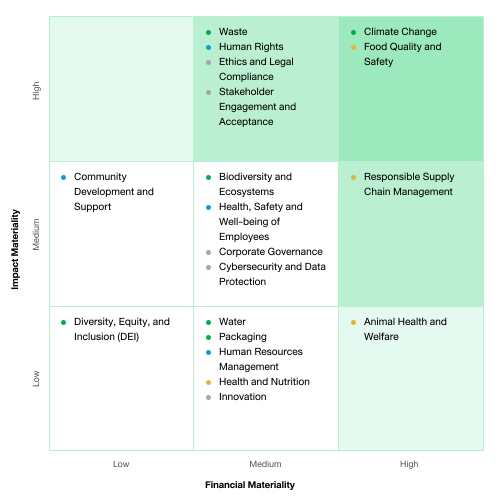
Through various workshops with our stakeholders' representatives to gather their views on CPF’s sustainable development, we are able to identify and prioritize issues that are most important for our stakeholders. These priority issues on economic, social, and environmental aspects are then used to define the contents in our Sustainability Report 2025.
Stakeholders
Engagement Channels and Frequency
- Conference Calls: Conducted throughout the year.
- Meetings with Analysts and Fund Managers: Held quarterly.
- Annual General Meeting (AGM) of Shareholders: Conducted once a year.
- Inquiries via telephone, email, and chat app: Available for continuous communication.
- Information Disclosure: Throughout the year via the Company's website and various company documents, monthly newsletters, stock exchange reports, and filings with the Securities and Exchange Commission (SEC).
- Regular Update Meetings: Held at least four times a year.
Issues of Interests
- Operational Performance and 3–5 Year Business Plan
- Growth Strategies and Policies
- Supply and Demand Dynamics for Livestock in Each Country
- Sustainability Initiatives
- Risks of Livestock Epidemics and Preventive Measures
- Innovation and Technology Development to Enhance Competitiveness
- Corporate Governance
- Risk Management
Actions and Responses
- Annual Reports and Quarterly Performance Reports provide clear information on operational results and long-term business plans.
- Monthly Investor Relations (IR) Newsletters provide regular updates for investors.
- Investor inquiries are routinely addressed.
- Regular website updates ensure up-to-date and accurate information.
- Monthly Industry Information Disclosure to share relevant industry data.
- Transparent Information Disclosures to comply with regulations and international standards.
- Shareholders have opportunities to propose meeting agendas, nominate qualified candidates for the Board of Directors, and submit feedback or questions.
- Company site visits are organized for stakeholders.
Benefits to Stakeholders
- Access to accurate, comprehensive, and timely Information to support informed investment decisions.
- Enhanced understanding of the Company's business, including risks and future outlook.
- Building trust and increase confidence with stakeholders.
- Protection of Shareholders’ Rights in accordance with legal requirements, corporate governance policies, and sustainability development principles.
Engagement Channels and Frequency
- Annual CEO Town Hall Meeting: Conducted annually
- Annual Business Unit (BU) Town Hall Meeting: Conducted annually.
- Employee Communications Channels: Regular information updates and communication through CPF Family, CPF Website, CPF Connect Mobile Application, CPF Facebook Page, Email, E-Newsletter, and HR Communications (clips and announcements) throughout the year.
- Labour Voices Hotline by LPN (one of CPF's civil society partners): Available year-round.
- Employee Satisfaction and Engagement Survey: Conducted every two years to assess organizational commitment.
- Welfare Committee Meetings: Held quarterly at each business unit.
- 19 Employee Clubs: Engaging employees through continuous activities throughout the year.
Issues of Interests
- Effective communication and employee feedback channels, encouraging open dialogue within the organization.
- Opportunities for skill and capability development, fostering continuous learning and growth.
- Work-life balance and flexibility, promoting a healthy and adaptable work environment.
- Fair and competitive compensation, aligned with industry standards, along with meaningful benefit and welfare programs for employees.
- Job security and career advancement opportunities, supporting long-term professional growth.
- Transparent performance evaluation, ensuring fairness and accountability.
Actions and Responses
- Individual Development and Career Planning, establishing personalized development plans and clear career progression pathways.
- Targeted Learning and Development Programs, focusing on job-specific responsibilities, digital skills, management and leadership development, and specialized professional competencies through both e-learning and hands-on business projects.
- Job Rotation Programs, facilitated through Opportunity Day activities and strategic job rotations to broaden knowledge, enhance experience, and diversify skill sets.
- Flexible Working Hours, designed to accommodate diverse employee lifestyles and promote work-life balance.
- Compensation and Benefits Alignment, structured in accordance with performance evaluations, while meeting or exceeding legal requirements, and remaining competitive within the industry.
- Family-centric benefits, offering comprehensive support, including scholarships for employees’ children, healthcare benefits, and special privileges for products and services within the CP Group.
- Mid-Year Goal Review, conducted in collaboration with supervisors to provide feedback and support the achievement of annual objectives.
Benefits to Stakeholders
For Employees
- Fair compensation and tailored benefits, ensuring equitable remuneration and benefits that align with individual needs.
- Clear career path and growth opportunities, enabling employees to enhance their potential and develop skills that meet business demands.
- Expanding knowledge, competency, experience and skills through job rotation programs.
- Work-life balance and flexibility, supporting efficient time management between work and personal life, with flexible arrangements tailored to individual circumstances.
For Families
- Stable career and income, providing employees with financial security and a sustainable livelihood, ensuring a good quality of life for themselves and their families.
- Family-centric benefits, offering comprehensive support, including scholarships for employees’ children, healthcare benefits, and special privileges for products and services within the CP Group.
- Enriching family engagement through company activities that strengthen relationships both within and outside the organization.
Engagement Channels and Frequency
- Customer Complaint Center: Accessible year-round through online channels, phone, and email.
- Continuous consumer demand research: Conducted throughout the year to stay aligned with market needs.
- Ongoing research on customer feedback: Regularly assessing customer responses to the company and its products across all product categories.
- Partner product demand research: Gathering insights into partners’ needs regarding products.
- Partner satisfaction research: Continuously evaluating partner satisfaction with the Company’s operations and services.
Issues of Interests
- Food quality and safety.
- Product label communication.
- Innovation in products and processes.
- Human Rights and Labor Practices.
- Corporate Governance and Business Ethics.
- Occupational Health and Safety.
- Management of Social Impacts on Communities.
Actions and Responses
- Internal coordination among relevant departments to investigate facts and take corrective action.
- Continuous product development to ensure products meet customer and consumer needs.
- Continuous research and innovation create new products that align with customer and consumer demands.
- Sustainability initiatives that address occupational health and community and environmental impact, such as using biodegradable packaging and employing eco-friendly production processes.
Benefits to Stakeholders
- Clear communication with consumers and providing compensation with new products as appropriate.
- Developing consumer-centric products that meet the needs and expectations of customers and consumers.
- Providing a brand that is socially and environmentally responsible.
Engagement Channels and Frequency
- Offline and online meetings: Ongoing communication throughout the year.
- Seminars and site visits: Held at least once a year.
- Special collaborative projects: Initiated as needed based on specific circumstances.
- Annual evaluations: Conducted at least once a year.
Issues of Interests
- Empowering farmers and business partners, throught knowledge sharing.
- Upholding high standards of ethical conduct in business operations.
- Ensuring the highest standards of food safety and quality.
- Promoting Human Rights and Fair Labor Practices across the supply chain.
- Managing environmental impact and ensuring responsible actions towards communities.
- Responsible sourcing and traceability of raw materials.
- Protecting the security and privacy of data.
Actions and Responses
- Business partner training programs, covering economic, food quality and safety, environmental, human rights, and corporate governance aspects through CPF Capacity Building for Partnership activities.
- ESG Business Partner Audits (ESG Audit) to verify business partners' adherence to Environmental, Social, and Governance (ESG) standards.
- Ensuring traceability of raw materials to verify they are free from deforestation, in collaboration with business partners.
- Human right impact assessment.
Benefits to Stakeholders
- Keeping business partners informed about major global business trends and regulations, such as the EU Carbon Tax, EU Deforestation-Free Regulation, and the EU Corporate Sustainability Due Diligence Directive.
- Helping business partners recognize the strengths, weaknesses, and environmental, community, social, and labor-related risks associated with their operations, enabling them to adjust and enhance their competitiveness.
- Supporting and encouraging business partners to prevent deforestation within the supply chain.
Engagement Channels and Frequency
- Community Needs Assessment: Conducted at least once a year to understand the evolving needs of the community.
- Community Engagement Activities: Collaborating with local communities and authorities to organize community outreach events around farms and factories, held at least once annually.
Issues of Interests
- Supporting the enhancement of community employment and income.
- Supporting child and youth development programs in the community.
- Prioritizing environmental sustainability in the company's operations.
Actions and Responses
- Supporting community engagement programs, promoting employment and income.
- Supporting child and youth development through dedicated initiatives for children and young people.
- Environmental conservation and biodiversity projects.
Benefits to Stakeholders
- Creating employment and income opportunities for communities surrounding farms and factories.
- Fostering strong relationships with communities through collaborative networks involving communities, the Company, government agencies, and strategic partners.
- Promoting age-appropriate development for children and youth, tailored to local contexts.
- Minimizing environmental impact from the organization’s operations.
- Restoring biodiversity through the conservation, protection, and rehabilitation of terrestrial and mangrove forests.
Engagement Channels and Frequency
- Year-round meetings with relevant government authorities.
- Collaboration and support for the initiation, development, and implementation of value-creation projects and activities.
- Exchanging of ideas through meetings and seminars held throughout the year.
Issues of Interests
- Transparent and fair business practices.
- Cooperation with government policies.
- Human Rights and Fair Labor Practices.
- Participation in R&D around science and innovation.
- Environmental management in production processes.
- Public disclosure of corporate information.
Actions and Responses
Cooperation with Government Policies
- Supporting government operations by providing data, such as international trade information, to aid in the development of free trade zone policies.
- Participating as members of various government committees.
- Providing feedback and helping disseminate key national legislation, such as the Draft Clean Air Act, the Draft Climate Change Act, and the Sustainable Packaging Management Act.
Human Rights and Fair Labor Practices
- Collaborating to address labor-related issues, including the 2024 list of products at risk of forced labor.
- Supporting the promotion of human rights policies with the Ministry of Justice, such as the National Action Plan on Business and Human Rights and the Model Organization for Human Rights Project.
Participation in R&D in Science and Innovation
- Providing information for, and support, the R&D of modern agricultural technologies in line with the Ministry of Agriculture and Cooperatives' policies.
Environmental management in production processes
- Providing data to support the development of wastewater discharge standards for the food industry under the Pollution Control Department.
- Collaborating on research to promote the sustainability of Thai fisheries in the Gulf of Thailand in partnership with the Department of Fisheries.
Benefits to Stakeholders
- The government is better prepared to implement international trade policies, such as negotiating with trading partner countries.
- The government gains factual data to support the development of key legislation tailored to the country’s context.
- Thailand’s image regarding labor practices and human rights improves, reducing negative impacts on trade and exports.
- The Ministry of Justice receives greater engagement from the business sector, such as an increased number of companies participating in the Model Organization for Human Rights program.
- The Ministry of Natural Resources and Environment obtains more comprehensive wastewater data from businesses to support the development of thorough environmental standards.
- The Department of Fisheries gains access to sustainability research on the Gulf of Thailand, supporting the formulation of sustainable fisheries policies while reducing the department’s research burden.
Engagement Channels and Frequency
- Continuous dialogue and engagement through meetings and seminars throughout the year, seeking opportunities to exchange ideas, obtain feedback, and gain knowledge.
- Support network-based collaboration as appropriate.
Issues of Interests
- Conducting business in alignment with the United Nations Sustainable Development Goals (UN SDGs)
- Adapting to clima.te change and integrating circular economy principles.
- Achieving Net-Zero targets.
- Ensuring transparent and fair business practices.
- Upholding human rights and fair labor practices.
- Disclosing information transparently, accurately, and in a timely manner.
- Research and development of food innovation.
- Animal welfare.
- Implementing social responsibility projects.
- Environmental management and natural resource utilization.
- Protecting biodiversity and ecosystems.
- Developing sustainable packaging.
Actions and Responses
- Providing opportunities for civil society and academics to visit and observe.
Benefits to Stakeholders
- Build confidence in the organization, serving as a model or example for further dissemination.
- Accurately share and disseminate the acquired knowledge.
Engagement Channels and Frequency
- Continuous communication to share relevant facts and foster understanding on important issues, through various channels such as press releases, interviews, press conferences, videos, reports, etc.
- Support and participate in media activities, such as seminars, anniversaries, and recreational events, to build and strengthen relationships.
Issues of Interests
- Business objectives and growth.
- Community responsibility for society and the environment, such as providing assistance in the event of disasters.
- Ensuring food security.
- Achieving Net-Zero goals.
- Promoting animal welfare.
- Upholding human rights and fair labor practices.
- Protecting biodiversity and ecosystems.
- Knowledge transfer to business partners, farmers, and communities.
- Implementing innovation and technology in production processes and the development of new food products
- Social projects that foster self-reliance and contribute to improving the quality of life in communities.
- Promoting access to food for children and youth.
Actions and Responses
- Provide accurate information to build understanding, awareness, and effective communication.
Benefits to Stakeholders
- Disseminate accurate information to the public.
- Foster understanding about the Company.