Sustainability at CPF

CPF is committed to strengthening food security through sustainable innovation. The Company builds its sustainability strategy on the Sufficiency Economy Philosophy of His Majesty King Bhumibol Adulyadej (Rama IX) and the CP Group’s ‘Three-Benefit’ principle, which focuses on creating value for the Country, the People, and the Company. CPF also aligns its operations with the Ten Principles of the United Nations Global Compact and actively supports the United Nations Sustainable Development Goals (SDGs) and the Paris Agreement, reinforcing its commitment to responsible business practices and long-term sustainable growth.
Sustainability Strategic Framework
In 2025, the Company conducted a sustainability materiality assessment across its agro-industrial and food value chain. The assessment reviewed key internal and external factors, including major economic, social, and environmental risks, and incorporated input from both internal and external stakeholders. The results were used to update the Company’s sustainability strategic framework, organized under three core pillars ‘C-P-F’, with seven priority focus areas and two supporting foundations.
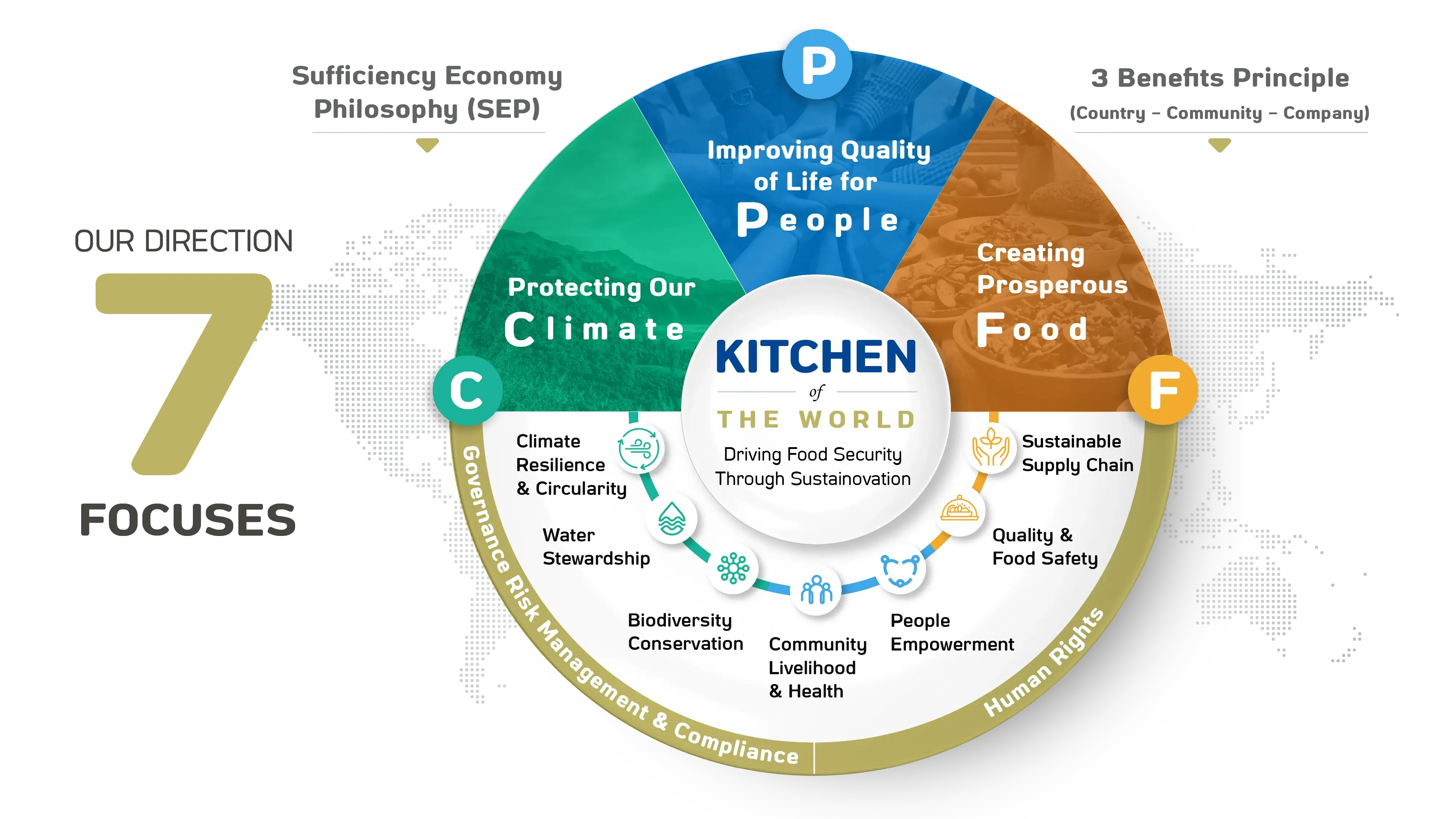
Additionally, these focus areas are aligned with the 17 Sustainable Development Goals (SDGs) and the Ten Principles of the United Nations Global Compact (UNGC).



Sustainability Governance
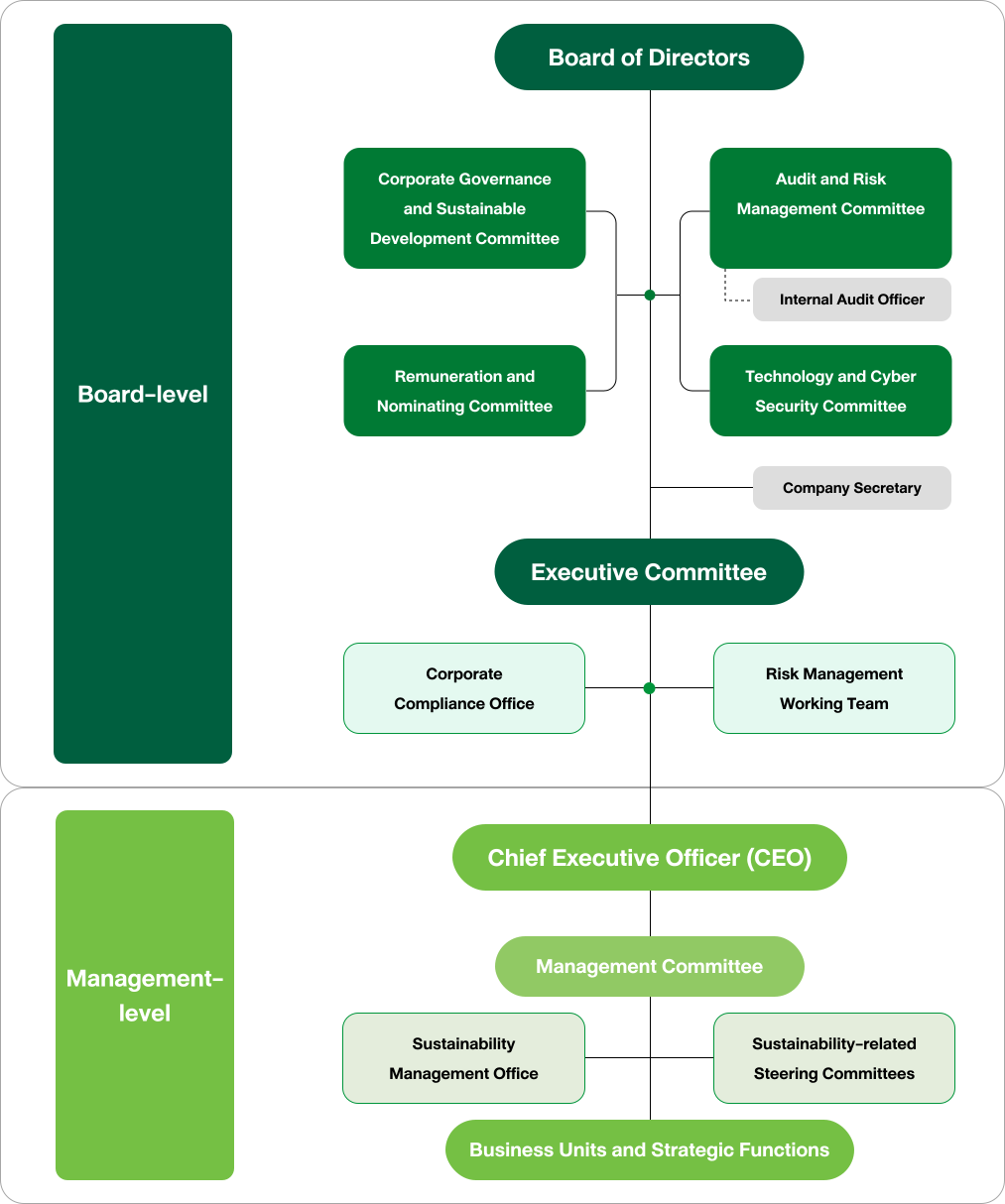
The Company has established a sustainability governance structure that integrates oversight at both the Board and management levels to ensure effective implementation. The Sustainability Management Unit coordinates and monitors performance against the sustainability strategic framework in collaboration with business units and relevant departments. This includes dedicated sustainability working groups responsible for key focus areas such as Net Zero Emissions and Environmental Sustainability, Sustainable Supply Chain Sourcing, and Animal Welfare. The Sustainability Management Unit operates under the supervision of Mrs. Kobboon Srichai, Head of Corporate Affairs and Investor Relations, who also serves as an Executive Director, Company Secretary, and Secretary to the Corporate Governance and Sustainable Development Committee.
Contributions to External Organizations and Associations
CPF believes that its participation in regulatory advocacy contributes to sustainability advancement in agro-industrial and food industry in ways that enhance the Company’s competitive edge in national and international markets. It is one of our responsibilities to the society and the countries in which we operate to assist more informed decision-making on the development of policies, laws, and regulations. It is also a way to promote sustainable development. We regularly participate as an individual company and through industry associations and trade associations, such as Thai Chamber of Commerce and Federation of Thai Industries, in forms of membership fee and support of other activities. In 2025, we contributed THB 8,889,446 to those organizations.
Contributions and Other Spending
Unit: THB
| 2022 | 2023 | 2024 | 2025 | |
|---|---|---|---|---|
| Lobbying, interest representation or similar | 0 | 0 | 0 | 0 |
| Local, regional or national political campaigns / organizations / candidates | 0 | 0 | 0 | 0 |
| Trade associations or tax-exempt groups (e.g. think tanks) | 8,080,204 | 8,268,738 | 9,516,392 | 8,889,446 |
| Other (e.g. spending related to ballot measures or referendums) | 0 | 0 | 0 | 0 |
| Total contributions and other spending | 8,080,204 | 8,268,738 | 9,516,392 | 8,889,446 |
2025 Top Three Largest Contributions and Expenditures
| Associations/ Institutions | Descriptions | THB |
|---|---|---|
| 1. Thai Broiler Processing Exporters Association | Thai Broiler Processing Exporters Association was established in 1991 to act as a regulating and service agency for the large number of Thai chicken meat producers and exporters. All of the association's members are leading Thai producers and exporters with decades of proven track record in the chicken industry. Thai Broiler Processing Exporters Association is well recognized as premium grade chicken product supplier to customers throughout the world, including Japan, Singapore, Hong Kong, South Korea, Middle East Countries, EU countries, South Africa and others. Visit www.thaipoultry.org for more information. | 3,829,725 |
| 2. Thai Feed Mill Association (TFMA) | Thai Feed Mill Association (TFMA) is a private non-profit organization. It was founded by a group of entrepreneurs, who have realized the importance of developing collaboration among livestock sectors in Thailand. Starting as a grouping, it was registered under the Trade Association Act, B.E. 2509 as Thai Feed Mill Association (TFMA) on December 25th, 1978. Its main objective is to assist members in solving problems affecting feed and livestock businesses. Visit www.thaifeedmill.org for more information. | 2,491,242 |
| 3. Federation of Thai Industries | Federation of Thai Industries (F.T.I.) is the private sector administrative juristic person to serve as the core organization and also as the center for all Thai industries in the kingdom of Thailand. It is a non-profit organization with the main duties of promoting and supporting the industry focusing on developing sustainable growth for all industrial operations in the country. F.T.I. is the core center in the following four areas: Centre of industrial co-operation among and with private sector and government sector in Thailand and abroad, Service center for all industrial developments, Activities center for all industrial operators, and Problem-solving center for all industrial enterprises in the kingdom, both member and non-members regardless of sizes and types. Visit www.fti.or.th for more information. | 421,782 |
CPF has collaborated with relevant associations/ institutions with the purpose of bringing changes for the better society through influencing policy and/ or law makers. As a vertically integrated agro-industrial and food business in animal proteins, we put high emphasis on development and promotion of sustainable production. Key initiatives that were supported by CPF in 2025 are as follows:
Advocacy on Human Rights and Responsible Business Conduct
A CPF representative serves as Vice Chair of the Labor Committee of the Federation of Thai Industries (FTI), which aims to enhance members’ knowledge and capabilities in conducting business in compliance with both domestic and international labor and human rights standards. As one of the FTI’s key committees, the Labor Committee acts as a representative body for its members, monitoring developments and facilitating engagement on labor and human rights issues at both national and international levels. Through appointed representatives, the Committee provides recommendations to government agencies and contributes to the development of national policies related to labor rights and human rights.
CPF has been entrusted by the Labor Committee to serve as a principal representative in various initiatives, including the development of Thailand’s First and Second National Action Plans on Business and Human Rights (NAP), as well as participation in the Subcommittee on Human Rights Model Organizations. In 2025, CPF’s representative engaged in discussions with representatives of the Organisation for Economic Co-operation and Development (OECD) regarding the development of legislation on Responsible Business Conduct (RBC). The objective is to strengthen responsible business practices in Thailand and establish requirements for Human Rights Due Diligence (HRDD) reporting.
CPF also represented the FTI in providing comments on the draft Responsible Business Conduct Promotion Act prepared by the Rights and Liberties Protection Department under the Ministry of Justice. The proposed legislation aims to require large enterprises to assess and report labor and human rights risks throughout their supply chains, in alignment with the United Nations Guiding Principles on Business and Human Rights (UNGPs).
Drawing on its practical experience in implementing Human Rights Due Diligence (HRDD), CPF supported the introduction of legislation promoting responsible business conduct while emphasizing the importance of a phased implementation approach. CPF recommended that legal obligations initially apply to enterprises with sufficient readiness and capacity, while priority should be given to strengthening the capabilities of small and medium-sized enterprises (SMEs). Subsequently, the Rights and Liberties Protection Department revised the draft legislation to focus its mandatory requirements on large enterprises and incorporated the concept of encouraging SMEs to collaborate with larger companies as part of the value chain and supply chain ecosystem.
Trade Association Membership and Public Policy Engagement on Climate Change
In line with Thailand’s commitments under the Paris Agreement, including the national targets of Carbon Neutrality and Net Zero Greenhouse Gas Emissions, and in response to increasingly stringent environmental regulations and carbon-related trade measures imposed by key trading partners—such as the European Union’s Carbon Border Adjustment Mechanism (CBAM)—the Thai government has accelerated the development of the Climate Change Act. The proposed legislation is intended to establish mandatory mechanisms for greenhouse gas measurement, reporting, and management, while facilitating the transition of Thailand’s economy toward a low-carbon future in a systematic and effective manner.
As a stakeholder directly affected by the proposed legislation, the Thai business sector, represented through the Joint Standing Committee on Commerce, Industry and Banking (JSCCIB)—comprising the Board of Trade of Thailand, the Federation of Thai Industries (FTI), and the Thai Bankers’ Association—has actively participated throughout the legislative drafting process. This engagement aims to ensure that the provisions of the Act are practical, aligned with business realities, and capable of effective implementation.
A CPF representative, acting on behalf of the Board of Trade of Thailand, participated in detailed reviews of the draft legislation as a member of the Climate Change Working Group under the Legal Subcommittee of the Department of Climate Change and Environment. In this capacity, CPF contributed recommendations regarding the composition of the National Climate Change Policy Committee, proposing the inclusion of representatives from the climate change working groups of the three principal business organizations to strengthen stakeholder participation and policy effectiveness.
In addition, CPF served as a representative of the Board of Trade of Thailand in consolidating feedback from the business community and submitting comments through all official public consultation processes. CPF consistently expressed support for the principles and objectives of the proposed Climate Change Act, including the acceleration of Thailand’s Net Zero target and the adoption of climate adaptation standards and mechanisms to enhance national resilience to climate change impacts.
The draft Climate Change Act is currently under review by the Council of State before being submitted to Parliament for legislative consideration and enactment. CPF remains committed to supporting constructive policy dialogue and contributing private-sector perspectives to help advance Thailand’s climate transition while ensuring a balanced and practical regulatory framework for businesses.
| Associations/ Institutes | Description |
|---|---|
| 1. The Science Based Target initiative (SBTi) | CPF Commits to Net-zero across the value chain by 2050 and is the first food processing company in the world with near- and long-term FLAG Science Based Targets validated by the SBTi. We are also among the first companies to set specific targets relating to forests, land and agriculture (FLAG). With 2020 as the base year, CPF commits to 42% reduction and 90% reduction of all 3 scopes of greenhouse gas non-FLAG emissions by 2030 and 2050, respectively. We further commit to 30.3% reduction and 72% reduction of Scope 1 and Scope 3 greenhouse gas FLAG emissions by 2030 and 2050, respectively. We also commit to zero deforestation across our primary deforestation-linked commodities by the fiscal year 2030. |
| 2. Agriculture and Food (F&A) Pathway under the World Business Council for Sustainable Development (WBCSD) | A global collective work of members on progressive business solutions to transform the food and agricultural systems, to achieve regenerative and equitable food systems. The Company is an active member in Agriculture & Food Pathway working group, which focuses on driving for greenhouse gas emission through innovation, positive agriculture, and sustainable diets. WBCSD regularly engages and contributes to policy-makers discussion, representing the private sectors’ interests in driving global climate actions. |
| 3. UN Global Compact Network Thailand (GCNT) | CPF is a co-founder to the local network of the world’s largest corporate sustainability initiative, the network works together to align strategies and drive operations to realize societal sustainability goals, with an environmental focus area on climate change. The network allows exchanges of best practices and opportunities to jointly drive for private-public sector commitment in pursuing Thailand’s net zero goal. It regularly works with governmental agencies to represent private sector’s interests relating to ESG. |
| 4. Thailand Supply Chain Network (TSCN) | CPF, along with the other 8 leading private companies, founded Thailand Supply Chain Network in 2019 with the aim to establish intercorporate collaboration among entrepreneurs to exchange information, knowledge and experience. The network supports Thai business in adhering to sustainable business practice throughout the entire supply chain, domestic or overseas. CPF is active in Sustainability and Circular Economy working, which has a strong emphasis on integration of ESG framework, the transition to become a low-carbon economy, and monitoring of emerging regulations. The Network regularly provides opportunities for members to exchange, engage and contribute to climate action-related policy drafting. |
| 5. TIPMSE | Thailand Institute of Packaging and Recycling Management for Sustainable Environment (TIPMSE) is an organization founded by corporate members and associations under Federation of Thai Industries to reduce amount of used packaging in waste countrywide. The network promotes appropriate management system for used packaging and recycled materials. By ensuring packaging waste is managed and recycled effectively, enabling circular economy, this helps reduce emissions associated in a packaging lifecycle. |
| 6. The Joint Standing Committee on Commerce, Industry and Banking (Board of Trade of Thailand, Federation of Thai Industries, Thai Bankers’ Association) | CPF advisor and representative from Trade Rules and Regulations Monitoring Office, on behalf of Board of Trade of Thailand, participate in Committee on Climate Change. The committee is responsible for establishing proposals for private sector in monitoring and driving policies in support of Thailand and private sector GHG reduction. Those include opinion provision for Climate Change Act and relevant measures. |
| 7. The Thai Chamber of Commerce and Board of Trade of Thailand | CPF representative from World Trade Regulations Office is designated by The Thai Chamber of Commerce as a main contributor to agricultural GHG reduction. The representative also serves as a sub-committee on climate change policy for Thailand agricultural sector, aiming to establish Thailand’s National Determined Contributions (NDCs). The sub-committee aims to uplift the understanding of GHG reduction in upstream value chain through the arrangement of training and seminar for the chamber members and farmers. |
| 8. The Federation of Thai Industries | CPF representative, from Trade Rules and Regulations Monitoring Office, participates in the Climate Change Working Group. The working group serves as a liaison with members of the Federation of Thai Industries to promote understanding and progress in Climate Change-Related Initiatives and also plays a role in advocating policy recommendations to the government in order to support the efforts of both industry groups and provincial members of the Federation. |
| 9. Thai Feed Mill Association | CPF supports the Thai Feed Mill Association’s policy to become a sustainable livestock supply chain. This includes creating collaboration among related sectors to achieve GHG reduction of three feed raw materials namely maize, cassava, and rice. The association collaborates with the Department of Agriculture and the National Science and Technology Development Agency (NSTDA) on sustainability and GHG assessment projects. CPF also supports the establishment of the Sustainable Livestock Office within the association. |
| 10. Thai Broiler Processing Exporters Association | CPF provides support to the Thai Broiler Processing Exporters Association for research projects including Environmental Assessment of Maize Plantation in Chiang Mai and GHG Reduction in Livestock Supply Chain through GHG measurement in maize plantation. |
| 11. Federation of Livestock and Aquaculture (comprising 15 associations) | The uplift of knowledge and understanding of the Federation members were arranged via communications and activities such as Workshop on Thai Livestock towards Net-zero Emission. |
| 12. Thai AEO Importer & Exporter Association | CPF advisor, as the President of the Association, continually raises awareness of carbon and arranges related activities among its members. |
| 13. Walmart’s Project Gigaton | C.P. Foods Product Inc., a subsidiary of CPF, is part of the Project Gigaton launched by Walmart in 2017. The project allows engagement on climate actions among suppliers, NGOs and other stakeholders, with the aim to reduce or avoid one billion metric tons (a gigaton) of greenhouse gases from the global value chain by 2030. CPF has received 2025 Giga-Guru Recognition from Walmart’s Supplier Recognition. |
| 14. ESG Network | Listed companies join hands as ESG Network, creating a space of learning and exchanges on ESG framework, as well as support the integration of sustainability into business operations. Private sector can collaborate with civil society and public sector to drive positive impacts and sustainability nation-wide. ESG Network works closely with Stock Exchange of Thailand and other governmental agencies to contribute opinions and feedback proposed regulatory directions. |