Biodiversity Impact Assessment
Ensuring food security is vital for the global population, particularly in the face of challenges such as biodiversity loss and the intensifying impacts of climate change. As an agro-industrial and food conglomerate deeply reliant on natural resources, protecting biodiversity and ecosystems is of utmost importance to us.
We are steadfast in our commitment to building food security while safeguarding natural capital. To this end, we have elevated our nature-related risk management by adopting the "LEAP Approach," developed by the Taskforce on Nature-related Financial Disclosures (TNFD). This framework serves as a comprehensive assessment guideline, enabling us to systematically identify, assess, and manage nature-related dependencies, impacts, risks, and opportunities across our entire organization. Furthermore, this initiative acts as a key mechanism in driving the implementation of the Kunming-Montreal Global Biodiversity Framework (KM-GBF).
L - Locate operational sites in proximity to ecologically sensitive areas
The Company analyzes operational sites covering its three core business categories: Feed, Farm-Processing, and Food. This assessment encompasses over 600 locations covering 12,550 hectares across 12 countries.
We have defined a 5-kilometer radius from our operational sites to identify overlaps with Key Biodiversity Areas (KBAs) and Protected Areas (PAs). Additionally, we analyze the extinction risk level of species listed on the IUCN Red List within a 50-kilometer radius of our operations. These analyses are conducted using the Integrated Biodiversity Assessment Tool (IBAT)."T
Conservation status of species within a 50-kilometer radius of the Company's operational sites, according to the IUCN Red List
E – Evaluate nature-related dependencies and impacts
The Company evaluates dependencies on ecosystem services and potential impacts of business operations on nature using the ENCORE tool. The results are based on the latest updated version (2024), enabling us to assess the materiality of each issue and guide the organization's natural resource management strategies.
Dependency
| Business Partner’s Activity | CPF’s Activity | |||||
|---|---|---|---|---|---|---|
| Feed Raw Material | Feed | Swine Farming | Poultry Farming | Aquaculture | Food Processing | |
| Provisioning Services | ||||||
| Biomass | ||||||
| Water Supply | ||||||
| Genetic Material | ||||||
| Regulating & Maintainance Services | ||||||
| Global Climate Regulation | ||||||
| Soil Quality Regulation | ||||||
| Water Flow Regulation | ||||||
| Rainfall Pattern Regulation | ||||||
| Storm Mitigation | ||||||
| Flood Mitigation | ||||||
| Water Purification | ||||||
| Air Filtration | ||||||
| Noise Attenuation | ||||||
| Solid Waste Remediation | ||||||
| Soil And Sediment Retention | ||||||
| Biological Control | ||||||
| Nursery Population And Habitat Maintenance | ||||||
| Pollination | ||||||
Impact
| Business Partner’s Activity | CPF’s Activity | |||||
|---|---|---|---|---|---|---|
| Feed Raw Material | Feed | Swine Farming | Poultry Farming | Aquaculture | Food Processing | |
| Changes in land and sea use | ||||||
| Area of Land Use | ||||||
| Area of Freshwater Use | ||||||
| Area of Coastal and Marine Use | ||||||
| Overexploitation of natural resources | ||||||
| Water Consumption | ||||||
| Other Resource Extraction | ||||||
| Climate Change | ||||||
| Emissions of GHG | ||||||
| Pollution | ||||||
| Air Pollution | ||||||
| Release of Soil Nutrient and Water Pollution | ||||||
| Generation and Release of Solid Waste | ||||||
| Ecosystem Disturbances (E.G Noise, Light) | ||||||
| Invasive alien Species | ||||||
| Introduction Invasive Species | ||||||
A – Assess nature-related risks and opportunities
The Company integrates findings from the nature-related dependency and impact analysis with risk assessment results from the WWF Biodiversity Risk Filter to evaluate risks and opportunities. This comprehensive analysis covers physical risks, transition risks, and business opportunities. The expected timeframes for risk materialization are classified as follows: 'Current' for short-term risks that have already occurred, '2030' for the medium term, and '2050' for the long-term perspective. These insights are integrated into our strategic decision-making processes and the corporate enterprise risk management system.
Transition Risk
| Risk | Dependency & Impact | Business Impact | Timeframe |
|---|---|---|---|
| Policy and Regulation | Impact
|
Future enforcement of domestic laws, such as the draft Climate Change Act, the draft Biodiversity Act, and the draft Sustainable Packaging Management Act. | Medium |
Impact
|
Future enforcement of laws in export destination countries, such as those under the EU Green Deal, including the EU Deforestation Regulation (EUDR) and the Carbon Border Adjustment Mechanism (CBAM). | Medium | |
| Technology | Impact
|
If alternative protein production technologies rapidly develop to lower costs and improve taste, environmentally conscious consumers may shift their behavior, leading to a decline in revenue from the core meat business. | Long |
| Market | Impact
|
Modern consumers and B2B partners increasingly demand Low Carbon Products or certified 'Deforestation-free' products. | Medium |
Physical Risk
| Risk | Dependency & Impact | Business Impact | Timeframe |
|---|---|---|---|
| Acute | Impact
|
Flash floods could cause damage to machinery, drowning of livestock, and disruptions to logistics and transportation. | Current |
Dependency
|
Ecological imbalance may increase the likelihood of frequent and acute animal disease outbreaks. | Long | |
| Chronic | Dependency
|
Long-term monoculture farming of agricultural raw materials leading to soil degradation, or erratic weather conditions causing low agricultural yields, will result in higher raw material costs. | Long |
Dependency
|
Droughts and degraded water sources may impact production, increase water sourcing costs, heighten the risk of disease outbreaks in aquatic animals, Challenges in co-managing water resources with local communities may arise, which could subsequently impact the Company's social license to operate and public trust. | Current | |
Impact
|
Rising average temperatures affect animal farming, necessitating additional investment in cooling systems and leading to higher electricity costs. | Long |
Opportunity
| Risk | Dependency & Impact | Business Impact | Timeframe |
|---|---|---|---|
| Resource Efficiency | Impact
|
Transforming waste and recycling water into resources based on Circular Economy principles helps reduce costs and decreases reliance on external natural resource. | Current |
| Product and Service | All dependency and impact | Developing products that cater to environmentally conscious consumers and aligned with global trends, such as low-carbon products and antibiotic-free products. | Current |
| Market | Impact
|
Gaining a competitive advantage in exports through the development of a comprehensive traceability system to verify that agricultural raw materials are deforestation-free. | Medium |
| Resilience | Impact
|
Encouraging farmers within the supply chain to adopt regenerative agriculture practices, such as soil enrichment, refraining from stubble burning, and planting cover crops. | Long |
| All depedency | Implementing Nature-based Solutions (NbS), such as mangrove planting, watershed forest restoration, and increasing green areas within the Company's farms and factories, to serve as natural windbreaks, barriers against noise, dust, and odors, and to assist in natural wastewater treatment. | Medium |
Based on the biodiversity impact assessment—which considers the proximity of operational sites to Key Biodiversity Areas (KBAs) and Protected Areas (PAs), along with each site's water usage and physical risk levels—11 livestock and aquaculture farms in Thailand, covering approximately 370 hectares, were identified as having a very high level of biodiversity risk. Mitigation approaches for these sites have already been established under the P – Prepare, as part of the company's broader action plan to manage these impacts.
P – Prepare strategies and action plans
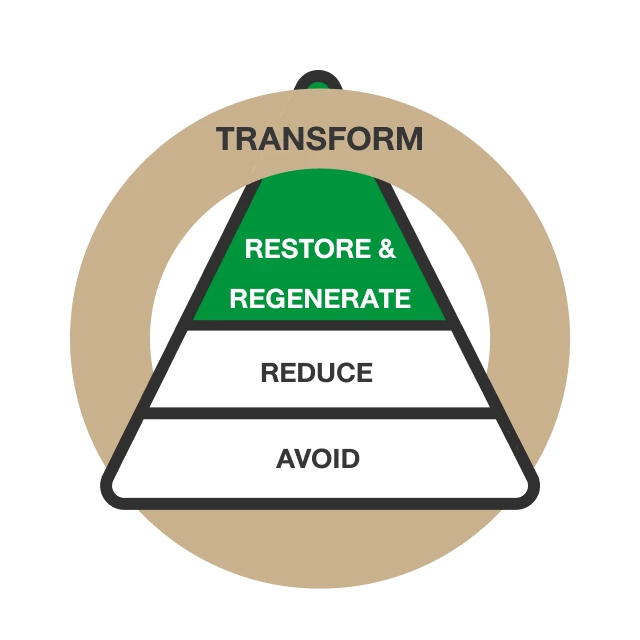
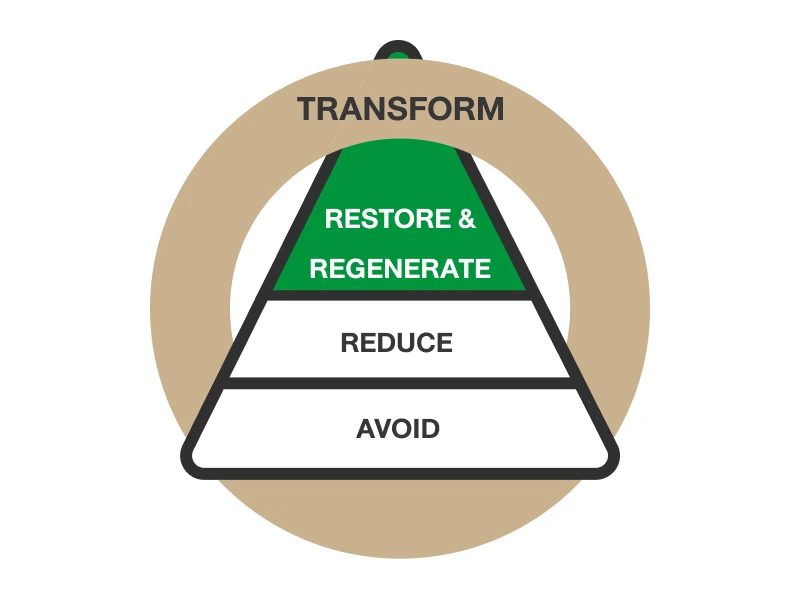
The Company has defined its biodiversity action plan using the AR3T mitigation hierarchy framework developed by the Science Based Targets Network (SBTN).
Avoid & Reduce
Avoid and reduce impacts that contribute to nature loss.
Restore & Regenerate
Restore and regenerate to enable nature to recover its integrity.
Transform
Transform underlying systems so that business becomes part of the solution to nature loss drivers.